


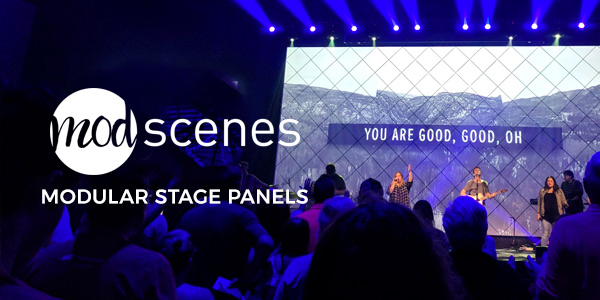
Sean King from Bethany Christian Assembly in Everett, WA brings us this weave design for Easter.
This was inspired by a design they saw on CSDI. They decided to take the single wall to the next level and remodel their entire front stage.
This was in the “weave” style of several designs seen on the website. They elected a sharp edged wall rather than a rolling style. This did create some challenges for them as we began hanging the horizontal pieces.
They began by painting the entire crowd-facing wall black to frame in the screens and make the rest of the design “pop.” Then they used 2×4 frame, then nailed to them 1x4s cut at with opposing angles, some inside, some outside facing to catch the walls as they came in or out of the weave.
Using a level, they worked from left to right, 4.5″ off of the floor using 3-2/4’s as blocks and attached with brad nails. After the first wall and many setbacks, they discovered that it was easiest to attach the outsides only, then attach the insides. They added 1×2″ blocking behind the pieces moving outward.
To finish the walls they used black 1×4’s painted black and added flat sheets of the paneling across the header.
They used very inexpensive Chauvet slim par 56’s for the top and ADJ Ultra Bar 10s on the bottom. The entire lighting system, 22 fixtures, cost around $2900. The lumber including paneling plus hardware was probably around $1,500.
The cross was built using simple 1×2″s and Coroplast. It was 16′ tall and had a 9′ cross member. 12″ wide and 10″ deep.
[IMAGES PRESERVED – 13 images]
Creating Dimensional Weave Walls
The weave wall technique offers a distinctive three-dimensional texture that transforms flat surfaces into engaging visual features. This approach creates depth through alternating panels that extend and recede, producing shadows and highlights that change throughout the day as lighting shifts.
The decision to use sharp edges rather than rounded curves gives this design a contemporary architectural feel. Sharp angles create crisp shadow lines and a more dramatic contrast between light and dark areas. This style works particularly well with LED lighting fixtures that can graze across the surface, emphasizing the dimensional quality.
The black background wall serves as a crucial framing element. By eliminating visual competition from the surrounding architecture, the weave pattern becomes the undisputed focal point. This technique of “framing with darkness” can be applied to any stage design where you want featured elements to command attention.
Pro Tips for Weave Wall Construction
Plan Your Layout First: Before cutting any materials, create a detailed drawing showing exactly where each panel will sit. Weave patterns require precise measurements, and mistakes compound quickly. Use graph paper or digital tools to map every piece.
Build in Sections: Rather than assembling the entire wall at once, construct manageable 4-foot wide sections on the ground. This allows for easier access, better quality control, and simpler installation. Just ensure your section breaks align with your weave pattern.
Label Everything: Every panel and frame member should be clearly labeled with its location before you move it to the stage. The weave pattern can be confusing during installation, and labels save significant time and prevent mistakes.
Test Your Lighting Early: Position your lights and test how they interact with the weave pattern before finalizing the wall placement. Adjusting the wall angle or light position by just a few degrees can dramatically change the shadow effects and overall appearance.
Related Designs
- Decorate Church for Easter: Step-by-Step – Volunteer guide for Easter preparation
- Complete Guide to Easter Church Decorations – Budget-friendly ideas for worship
- Stunning Easter Decor Ideas – Real church examples
- Easter Boxes – Geometric coroplast design with LED
- Honeycomb Easter – Paper-based textured backdrop
Related: Origami Doves Soar in Easter – Another community craft-based Easter design


Leave a Reply
You must be logged in to post a comment.