



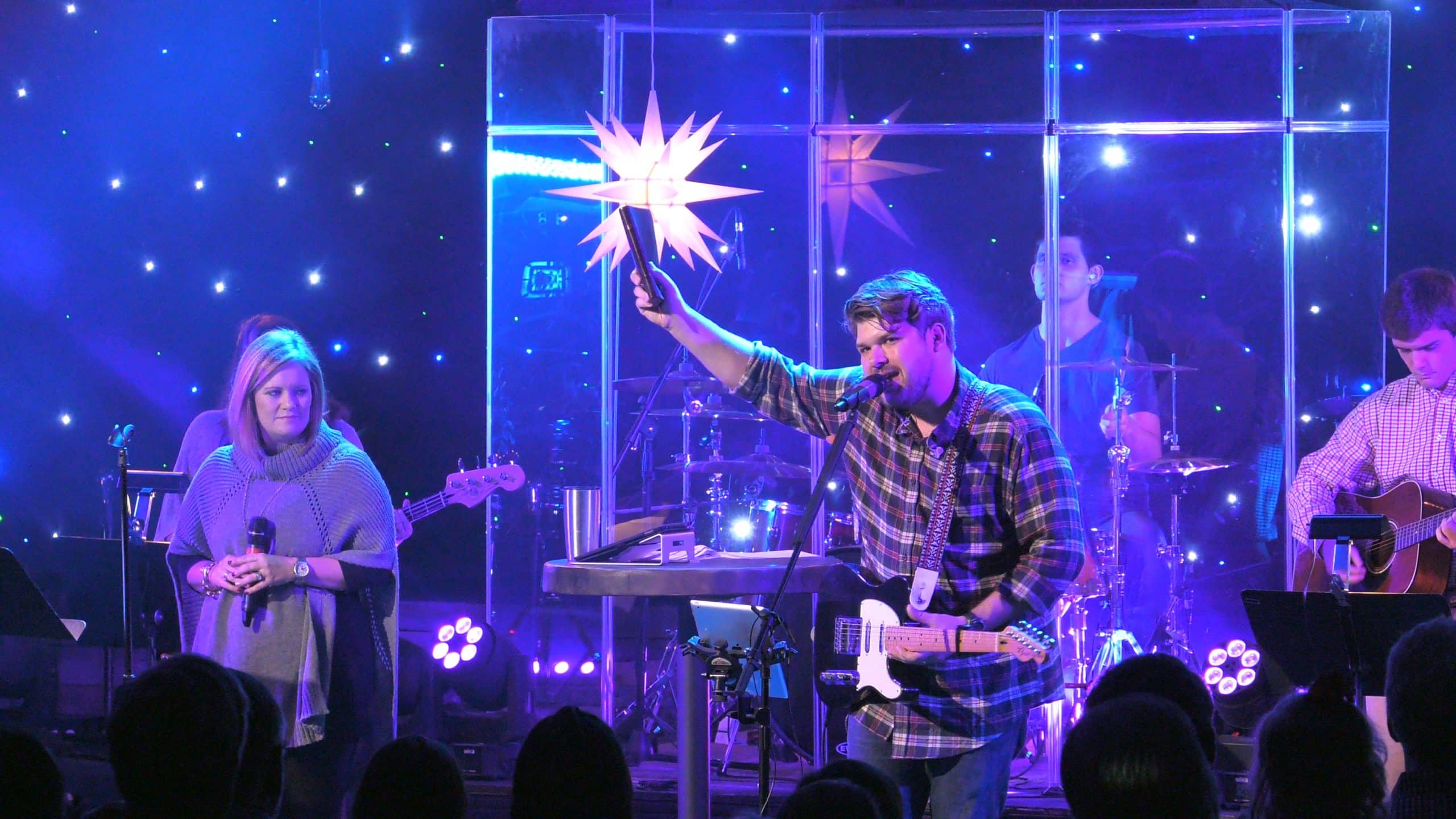
Cameron Helwege from Statesboro First United Methodist Church in Statesboro, GA brings us this starry stage design for Christmas.
From Cameron: Our Advent series was The Wonder of Christmas. We wanted folks to walk in to our Christmas Eve service and be filled with awe and wonder. We projected a sky full of stars on the walls and ceiling of the room. The stage area has a lot of dark surfaces and we didn’t think projection would create the impact we were going for in that area, so we opted for star curtains. We ordered 5 6’x10′ panels, each of which are DMX controllable. The panels were $170 each, for those wondering about cost. We put three on the back wall and one on each side of the proscenium. Each curtain has a controller box where the dmx and power connections were made and then a 5 pin pigtail between the box and curtain itself. The curtains we used have grommets for mounting and included Red, Green, Blue, and White stars that could be dimmed independently, which we were able to incorporate into lighting changes for different songs.
We also used a second platform off to the side to allow for tighter transitions and make our space feel larger. We did a lot of things differently in this service that created a big impact for folks who came to participate. Our house lights were off for a majority of the service, we used way more haze than normal, we used burlap to cover some of the more recognizable features of the room, we used aromas. Changes like this, while subtle, helped to transform our space into something completely new and different and allowed for a Wonder-filled Christmas Eve.



How to Plan an Immersive Star-Curtain Stage
A convincing night-sky environment starts with coverage, not brightness. Map the audience sightlines, livestream camera crop, stage entrances, screens, speakers, and architectural gaps before ordering curtain panels. The five-panel arrangement in this design placed three panels across the back and one on each side of the proscenium, extending the visual idea beyond a single backdrop. That wraparound placement helps the room feel larger and keeps the effect visible in wide camera shots.
Before purchasing, confirm the dimensions of each panel, grommet spacing, controller location, power draw, DMX connector type, and the distance between the controller and fabric. Make a scale elevation of the room and mark every attachment point. Dark gaps can be useful when they create depth, but accidental seams or exposed cables will break the illusion. Allow enough slack for strain relief while keeping power and data paths away from walkways.
Programming Stars, Projection, and Atmosphere
Program the red, green, blue, and white channels independently instead of treating the curtain as a single effect. White can establish a natural star field, while subtle color shifts can support different songs without turning the background into a distraction. Build a few restrained looks: a dim static scene for speaking, a slow shimmer for reflective moments, and a brighter cue for musical peaks. Fast flashing should be used cautiously and evaluated for accessibility.
Projection on the walls and ceiling expands the sky beyond the platform, while the physical curtains solve the problem of dark stage surfaces that do not reflect projected light well. Match the apparent density and color temperature of the projected stars to the curtain LEDs. Haze can make beams and projected texture more visible, but use only venue-approved fluid, follow equipment guidance, coordinate with fire-safety systems, and test the effect from both the room and the camera.
Immersion also depends on what the audience does not notice. Covering familiar room features with neutral fabric, reducing house light, and using a secondary platform can reshape how people perceive the space. Rehearse every transition with performers and volunteers so low-light movement remains safe. Keep exits, aisle lighting, and required safety illumination unobstructed, and secure overhead or wall-mounted panels with hardware appropriate for the actual load.
Pro Tips for a Starry Church Stage
Address every controller: Label each panel, controller, power lead, and DMX address so troubleshooting does not interrupt rehearsal.
Balance for cameras: Check exposure and flicker at the exact frame rates used for recording and streaming; a look that feels bright in person may clip or disappear on video.
Create visual depth: Separate the curtain from the rear wall when space allows, and keep performers far enough forward that the stars remain distinct behind them.
Save a safe default: Store a low-intensity white look that volunteers can recall quickly if a cue, controller, or color program behaves unexpectedly.
Related Designs
- Star Strings – Build dimensional star-pattern panels from wood frames, yarn, and LED tape.
- Shooting Stars & Bricks – Combine animated LED lines with a textured brick environment.
- Star Falls – Create a glowing field with suspended LED neon tubes and layered backlight.
- Falling Stars – Explore another overhead star treatment that draws the eye across the room.
- Mountains and Stars – Pair a celestial background with a dimensional scenic silhouette.


Hey Cameron!
Great design. I have some family that live in Statesboro.
Can you link where you got the LED curtains from? Would like to look into them. Thanks!
Thank you!
We ordered the curtains from Amazon http://a.co/86MeIGb. I ordered one to make sure it would work how we needed. I was unsure of the product as the price seemed lower than what I would have expected, but it turned out to be exactly what we were looking for with DMX control and all.
We did look into renting the curtains, but that option ended up being way more expensive once you add in the freight shipping.