


Working with low ceilings in your stage design space? That’s the challenge Joey Riggins and his team at Lighthouse Church in Panama City Beach, Florida was faced with.
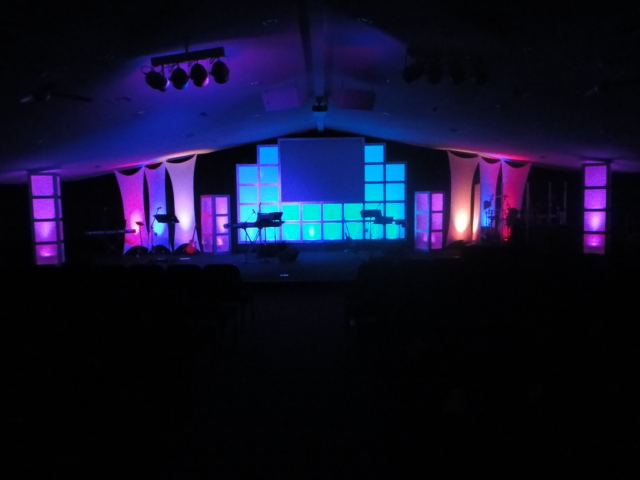
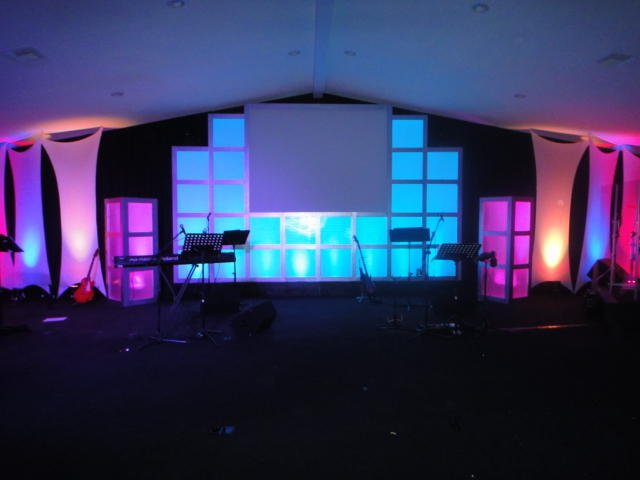
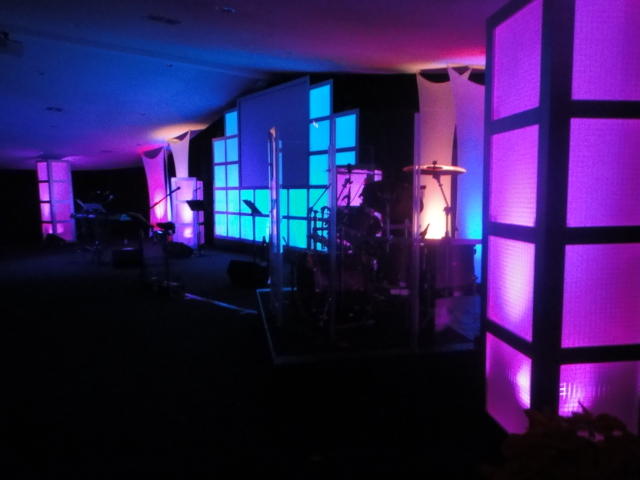
To overcome the challenges of short real estate, they created a design that flowed with the natural shape of the room and used tall elements on the ends of the stage to create a sense of height. All boxes were constructed using 1×4’s and light covers from Home Depot. They glued mirrors to the tops of the boxes to reflect the LED uplighting back down. They used spandex to fill in blank spots in the design.
They also dyed our tan carpet black using $100.00 of Rit clothing dye and spray bottles.
Designing for Low Ceiling Spaces: Creating Height Through Visual Trickery
Low ceiling challenges are among the most common constraints church stage designers face, particularly in converted retail spaces, older buildings, or multi-purpose rooms. The team at Lighthouse Church demonstrates several professional techniques for overcoming vertical limitations without major construction. Their approach relies on visual psychology—creating the impression of height rather than actually changing the architecture.
The strategic placement of tall elements at the stage periphery draws the eye upward and establishes vertical reference points that contrast with the actual ceiling height. This technique, known as vertical emphasis, is a fundamental principle of interior design that translates beautifully to stage environments. By placing the tallest elements at the outer edges of the stage, they create a frame that suggests expansive space beyond the visible area. The viewer’s brain fills in the gaps, perceiving more height than actually exists.
The mirror-topped boxes represent an ingenious solution to the lighting challenges that often accompany low ceilings. In confined vertical spaces, traditional overhead lighting can create harsh shadows and flat, unflattering illumination. By reflecting LED uplighting downward, the mirrors create a soft, diffused glow that adds dimension without requiring additional vertical clearance. This technique effectively doubles the perceived light sources while working within the physical constraints of the room.
The choice of spandex as a fill material demonstrates resourceful problem-solving. Spandex stretches tight, creating smooth surfaces that catch and reflect light beautifully. Unlike rigid materials that require precise measurements and cutting, spandex forgives minor imperfections in construction and can be tensioned to create visually clean lines. Its lightweight nature also makes installation and removal manageable for volunteer teams.
Construction Techniques for Mirror Box Stage Elements
The mirror boxes in this design serve multiple purposes: they add dimensional interest, provide reflective surfaces for lighting effects, and create the vertical emphasis needed to overcome low ceiling limitations. Constructing these elements using 1×4 lumber keeps the weight manageable while providing sufficient structure for the mirrors and light covers. The use of standard dimensional lumber means no special cutting or milling is required—an important consideration for volunteer-built sets.
Light covers from Home Depot provide an affordable, readily available alternative to custom-fabricated diffuser panels. These covers, designed for fluorescent fixtures, are engineered to spread light evenly—exactly the quality needed for stage lighting applications. Their plastic construction makes them lightweight and safe to handle, while their standardized sizes simplify construction planning.
When attaching mirrors to the box tops, adhesive selection is critical. Standard construction adhesives may not bond well to glass or mirror surfaces. Mirror mastic or specialized mirror adhesive provides the strong, permanent bond needed for safety and longevity. For temporary installations, heavy-duty Velcro or mirror clips can secure the mirrors while allowing for removal and reuse.
The carpet dyeing technique mentioned in the original post deserves special attention as a budget-stretching strategy. Rather than replacing existing carpet, the team transformed it for approximately $100 in dye and supplies. Rit dye, typically used for fabrics, can work on carpet fibers when properly applied. The spray bottle application method allows for controlled coverage and gradual color building. This approach requires patience and proper ventilation but can dramatically change a room’s appearance for a fraction of replacement cost.
Related Designs
- Big Stage on a Small Stage – Learn how to maximize visual impact in compact spaces with clever scaling and perspective techniques.
- Video Boxes – Discover how to integrate projection and LED panels into box structures for dynamic multimedia stage elements.
- Boxed In – Explore another creative approach to using dimensional boxes for architectural interest and lighting opportunities.
- Ceiling Art – See how to turn ceiling limitations into design features with artistic overhead treatments.
- Glowing Columns – Learn techniques for creating illuminated vertical elements that draw the eye upward and expand perceived space.
Pro Tips for Low Ceiling Stage Design
Maximize Vertical Lines: Use tall, narrow elements like columns, banners, or vertical light strips to create upward visual movement. The eye naturally follows vertical lines, which helps overcome the psychological impact of low ceilings. Avoid horizontal elements that emphasize width over height.
Layer Your Lighting: Low ceilings can create challenging lighting conditions. Use uplighting to wash walls and vertical elements, creating the impression of height. Avoid overhead fixtures that draw attention to the ceiling plane. Backlighting translucent elements can also create depth without requiring vertical space.
Choose Low-Profile Fixtures: When selecting stage lighting equipment, prioritize low-profile LED fixtures that can be mounted close to the ceiling or on the floor. Modern LED pars and strip lights provide excellent output while minimizing physical intrusion into the limited vertical space.
Create Focal Points at Eye Level: When you can’t go up, go bold at eye level. Create compelling focal points using texture, color, or lighting that capture attention without requiring height. A well-designed mid-stage element can become the visual anchor that distracts from ceiling limitations.
Related: Multi-Purpose Squares – See how SALT Nashville created versatile LED squares that work as projection surfaces, pixel-mapped displays, and symbolic stage elements.
Related: Hexagon String Art – Discover how Village Baptist Church created stunning hexagon and hourglass shapes with RGBW LED lighting and creative string art patterns.


This is a nice look.
Did they create each box and then stack them? Did they use spandex on the boxes as well?
They are all one continous piece but the separate boxes are a nice idea. We have since laid the columns on their sides and angled them to create a different look for Kids Church and Youth Sanctuary.
How well did the Rit dye work on the carpet? Is it wearing pretty well? What was the process you used to apply the dye? Did you use the powder or the liquid dye?
Thanks!
What type of lighting specifically do you use behind the spandex?
Thanks!
By “Light Covers” do you mean the drop ceiling plastic insert light covers? Can I get specifics about the LED lighting?
I love this church and Pastor Cole! I also love how you guys are using your spaces to create a warm and inviting atmosphere for people to connect with God and each other. Good job!