



In this article, Glendale Matias talks about using and building stage flats in your stage design. What are stage flats, how do you build them, and should you use broadway or hollywood flats?
In stage design, designers work to create a visually stimulating environment. Using the elements and principles of design, they create context that ultimately transforms the space on the stage. There are numerous tools a designer can use to achieve this including building dimensional props, controlling light fixtures, draping cloth—but the most common method is constructing stage flats (short for scenery flats).
Flats are a great tool for any stage design. You can create a great deal of depth and visual interest using a small amount of material while occupying minimal stage space. They are very versatile, can be reused many times, relatively lightweight, mobile and can be easily stored. There are two styles of stage flats: Hollywood (TV, Hard flats) and Broadway (Soft).
Stage Flats vs Stage Walls: What’s the Difference?
Stage flats are portable, temporary structures made of lightweight materials like canvas or plywood stretched over wooden frames. Stage walls are permanent architectural features built into your church building.
Key differences:
- Flats: Portable, reusable, affordable ($50-200 each), easy to store
- Walls: Permanent, expensive to modify, require construction
For most churches, stage flats offer the flexibility to change designs seasonally without major construction costs.
What are Broadway Flats?
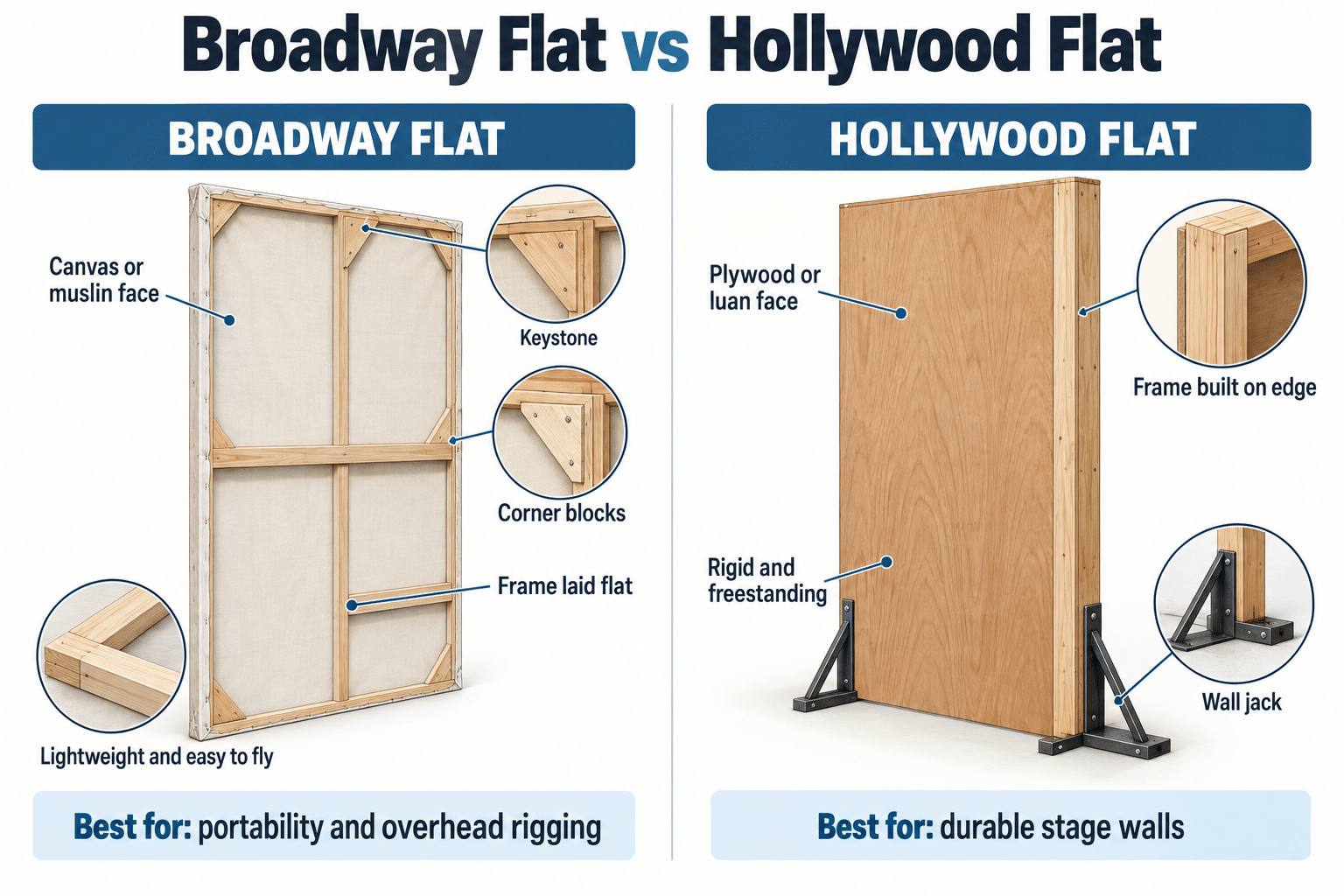
Broadway flats are much lighter. They’re constructed using muslin or canvas stretched on a thin wooden frame. They can be suspended from a fly tower for presentation or storage.
What are Hollywood Flats?
Hollywood flats, on the other hand, are constructed more rigidly using luan or plywood with wider stiles (or side bars). They can stand freely from the ground using wall jacks or can be anchored directly to a movable base or stage. These are heavier and require more lumber, but can support windows and other rigid detailing. Both have their advantages and disadvantages, but overall, the structure and concept are the same.
Broadway Flat vs Hollywood Flat: Which Should You Choose?
| Feature | Broadway Flat | Hollywood Flat |
| Weight | Lightweight (10-15 lbs) | Heavier (20-40 lbs) |
| Best For | Hanging, flying scenery | Free-standing, detailed work |
| Cost | $30-60 per flat | $60-150 per flat |
| Storage | Can fold flat | Requires more space |
| Detail Work | Limited | Supports windows, cutouts |
Choose Broadway flats if: You need lightweight, portable scenery that can hang or be moved frequently.
Choose Hollywood flats if: You need free-standing walls with detailed architectural features.
How do I build a stage flat?
Flat construction consists of a wooden frame, a frame skin (surface usually wood or cloth) and a frame stand. Here is some terminology:

- Rails – The top and bottoms of the flat. Usual size is 4′ in length.
- Stiles – The sides of the flat. The length of the stile is the height of the flat (usually 8′, 10′, 12′).
- Toggles – These are crosspieces that run between the stiles. They provide strength and rigidity and keep the flat square.
- Corner blocks – Corner blocks are used to attach the rails and stiles. They also keep the flat square. They’re usually made of plywood/masonite squares (triangles also keep the flat square).
- Keystones – Keystones join the stiles and toggles together. They’re usually rectangle or ‘keystone’ in shape.
- Skin – Plywood, luan, canvas, muslin, or butcher paper.
- Base/Wall Jacks (for free standing flats) – A support that keeps the flat braced and standing. They can be right triangle frames that connects to both stiles and anchored or weighted down.
Flats are a great method for creating context for the stage. They are extremely versatile for almost anything requiring a backdrop or visual presentation. Due to their incredible mobility, a stage can be easily transformed between scenes or events by simply rearranging the flats. Stage flats can be stored flat and reused, which helps to reduce costs.
I use stage flats for anything that needs to convey information. They are the quickest way to deploy and execute. In combination with an opaque projector (or LED projector) a design can be quickly sketched, painted and assembled.
Frequently Asked Questions About Stage Flats
How much do stage flats cost?
DIY stage flats typically cost $30-150 each depending on size and materials. Broadway flats (fabric) are cheaper at $30-60, while Hollywood flats (plywood) cost $60-150. A complete 20-foot backdrop might require 4-6 flats ($120-900 total).
What materials do I need to build stage flats?
Basic materials include: 1×3 or 1×4 pine lumber for frames, plywood/luan/canvas for skin, corner blocks, wood glue, screws, and wall jacks (for free-standing). Most materials are available at Home Depot or Lowe’s.
Can stage flats support weight?
Hollywood flats can support light weight (decorations, small props) but shouldn’t bear heavy loads. Broadway flats support minimal weight. For heavy props, build dedicated support structures rather than relying on flats.
How do you store stage flats?
Store flats vertically against a wall or lay them flat in stacks. Broadway flats can fold if constructed with hinged corners. Keep in a dry area to prevent warping. Label each flat with dimensions for easy selection.
What is a Hollywood flat in theatre?
A Hollywood flat (also called a TV flat or hard flat) is a rigid stage flat built with plywood or luan on a sturdy wooden frame. Unlike Broadway flats that use fabric, Hollywood flats are solid and can stand freely with wall jacks.
Glendale is a graphic designer at Disney and does stage and scenic design for his church in Los Angeles, Oasis Church.
Related Stage Design Resources
- Stage Flooring Options for Churches
- 10 Stunning Wall Light Panel Ideas for Church Stage Backdrops
- The Anatomy of a Church Stage Design: Essential Elements Explained
Related Stage Design Resources
Learn more about building and designing church stages:
- Stage Flooring Options — Complete guide to church stage flooring materials, costs, and installation tips
- How to Use Lighting in Church Decoration — Transform your sanctuary with strategic lighting design
Vertical Alternative: Columns and Mod Scenes – While stage flats create horizontal backdrops, this design demonstrates how vertical spandex columns can add height and visual interest using similar lightweight materials.
Grow Your Business By Advertising with Us!
Church Stage Design Ideas is trusted by hundreds of thousands of pastors and church leaders per year. Get your message in front of decision makers with one of our sponsorship plans.
Related CSDI guide: Download ready-made church stage design ideas for a faster starting plan.
Planning Stage Flats for a Church Platform
A useful flat starts with a measured plan, not a stack of lumber. Record the platform width, ceiling height, door clearances, screen locations, sprinkler clearance, and the paths musicians and volunteers use during a service. Then sketch each flat as a module that can move through the narrowest doorway and fit the available storage area. Standardizing two or three panel widths makes the set easier to rearrange for future sermon series without rebuilding everything.
Decide how the finished surface will be viewed before choosing materials. A flat that sits behind a band and receives saturated color can use a simple paint finish. A panel seen close to the congregation or on a tight camera shot may need filled seams, smoother fabric, or a textured scenic treatment. Build and light a small sample first. The camera can reveal wrinkles, reflective patches, and gaps that are difficult to notice from the room.
Bracing, Joining, and Moving Scenic Flats
Freestanding flats need a support plan sized for their height, weight, location, and expected contact. Stage jacks, base plates, sandbags, and approved anchors are common solutions, but the right method depends on the room and local requirements. Connect neighboring flats with bolts, coffin locks, or other rated hardware so volunteers can assemble the wall consistently. Avoid relying on loose screws driven into the same holes after every reset because the connection becomes less predictable over time.
Add handles or protected handholds where they will not show from the audience. Label each panel, brace, and hardware bag with a matching code, and photograph the completed setup from the front and rear. A simple diagram showing the order of assembly can turn a future installation into a repeatable volunteer project. When the flats are stored, keep them upright in a secured rack with spacers that protect painted faces and prevent panels from tipping.
Plan maintenance as part of the build. Keep a small container of matching paint, filler, fasteners, and replacement fabric. Inspect joints, bases, braces, and flame-retardant documentation before each installation. If a panel becomes warped, cracked, damp, or difficult to stabilize, remove it from service until it is repaired. Scenic construction should always be reviewed by the church’s facilities or safety lead, especially near exits, electrical equipment, sprinklers, or overhead rigging.
Pro Tips for Better Stage Flats
Design around storage: Measure the storage rack and travel path before selecting panel dimensions, then leave room for hands and protective spacers.
Number every connection: Matching labels on flats, braces, and hardware reduce setup mistakes and help volunteer teams work without guessing.
Test the camera view: Check the sample under house lighting and stage lighting, using the same exposure and angles used for livestreams.
Schedule safety checks: Inspect bases, fasteners, fabric, and finish before each reuse, and document any repair before returning a flat to the stage.
Related Designs
- How to Create a Stage Set for Any Sermon Series – Turn reusable scenic modules into a flexible visual system for changing themes.
- Small Church Stage Design Ideas for Real Rooms – Match scalable set concepts to practical room dimensions and budgets.
- Best Materials for DIY Church Stage Design – Compare common scenic surfaces, framing choices, costs, and tradeoffs.
- The Anatomy of a Church Stage Design – Coordinate scenery with lighting, screens, musicians, and audience sightlines.
- Wall Light Panel Ideas for Church Stage Backdrops – Explore dimensional panel treatments that combine structure and light.
Related: Angels and Demons – See how stone-look foam-board walls become part of a dramatic church stage composition.


Our stage flats are invaluable to us! They are 2×4 frames, covered with canvas. A local welder made us rolling stands that the 4′ x 8′ sections slip into for super adaptable staging, scene changes and maneuverability that can be easily handled by one crew member. They’re also still lightweight enough to be hung from our trussing and store in a closet when not in use. Win, win, win!
Would you be willing to share how you made your stage flats with the rolling stands?
Hi, Tracie – so sorry for the delay in responding but Christmas production frenzy was on us. :) Our stage flats are just as Glendale describes above but to get them to fit into the rolling stands, we leave off the bottom corner blocks. The canvas does need to be stretched and cornered very carefully to fit into the stand smoothly but that’s not difficult to do.
It’s probably easier to show you the design than for me to try to describe them but I’m not seeing a photo option in the comments here, so I’ll do my best.
The rolling stands are a metal stock that has roughly the same dimensions as a 2×4 but are hollow. This stock was welded into a big capital letter “I” (think Times New Roman upper case I) for the base, approximately 4′ 4″ long with the top and bottom of the I being about 12″ long. Industrial pivoting casters were installed on each end of the top and bottom to form the rolling base. Then a 10-12″ section was welded standing up from the intersection of the base pieces with metal tabs welded onto the long section of the base and the upright sections to form guides and braces for the flats. Then we painted them black and voila! The flats slide in from the top and become free standing, reversible and mobile.
They do end up with a small gap between them but for staging that’s never really been a problem. For stationary sets, we hang black paper or fabric between so that no motion is visible behind them. We also drilled holes so they could be locked together if necessary, but for most of our sets we want smaller, more mobile pieces.
If that wasn’t clear enough, and you’d like to see some photos, feel free to contact me at val (at) valeriecoulman (dot) com, and I’d be happy to send some to you. Happy New Year!
What does Construction on edge mean?