


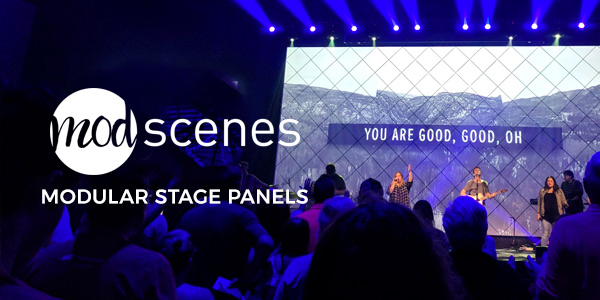
The design team at Southeast Christian Church in Louisville, Kentucky used these for their Night of Worship event.
Because of their focus on recording and video production for the night, the stage design got put on the back burner. With that in mind, Joel went to the local hardware store and bought several fluorescent light covers and went to town. He linked three sections together by grommeting the corners and using threaded connectors. He then lit them from the bottom with MAC TW1s. (Though any fixture will do fine.)


Why This Design Works
The genius of this stage design lies in its elegant simplicity and remarkable cost-effectiveness. Fluorescent light covers, also known as diffuser panels or egg crate louvers, are designed to distribute harsh fluorescent light evenly across office spaces. When repurposed for stage design, these panels create a translucent surface that catches and diffuses theatrical lighting beautifully, producing a soft, ethereal glow that adds depth and dimension to your worship space.
The modular approach of linking three panels together demonstrates smart scalability. By grommeting the corners and using threaded connectors, Joel created a flexible system that could be arranged in various configurations depending on the stage layout and desired visual impact. This adaptability means the same materials can serve multiple events and sermon series throughout the year, maximizing your investment.
From a technical standpoint, lighting these panels from below with MAC TW1 fixtures creates an upward wash that emphasizes the grid pattern of the diffuser panels. This technique transforms ordinary materials into something that appears custom-designed and professionally crafted. The grid pattern catches the light in interesting ways, creating subtle shadows and highlights that add texture without overwhelming the stage.
Materials and Construction Guide
The primary material for this design is standard fluorescent light diffuser panels, readily available at any home improvement store for just a few dollars each. These panels typically come in 2×4 foot sections and are made from acrylic or polystyrene. When selecting panels, look for ones with an interesting grid or prismatic pattern, as these create the most visual interest when illuminated.
To connect the panels, Joel used metal grommets installed at the corners of each panel. Threaded connectors, such as small bolts or specialized panel connectors, pass through these grommets to link multiple sections together. This method allows for easy assembly and disassembly while maintaining structural integrity during use.
The lighting setup is equally straightforward. MAC TW1 fixtures or any similar wash lights positioned at the base of the panels provide upward illumination. This uplighting technique is particularly effective because it highlights the texture of the diffuser panels while creating a sense of height and drama. The fixtures can be positioned on the floor or on low platforms, keeping them out of sight while maximizing their effect.
Adapting This Design for Your Space
One of the greatest strengths of this concept is its flexibility across different venue sizes and budgets. For smaller stages, a single panel or a pair of panels may provide sufficient visual impact without overwhelming the space. Larger venues can scale up by creating wider arrays of connected panels or by stacking them vertically for added height.
The panels can be hung from existing stage rigging, supported by freestanding frames, or even mounted against a back wall depending on your space’s infrastructure. For churches without extensive lighting equipment, simple LED par cans or work lights can substitute for professional fixtures, though the color rendering and intensity may vary.
Consider experimenting with colored gels or LED color mixing to match your worship themes or seasonal celebrations. The translucent nature of the panels means they respond beautifully to color changes, allowing you to transform the atmosphere from warm and intimate to vibrant and energetic with simple lighting adjustments.
Related Designs
- Radiant Pillars – Wooden pillars with DIY LED tube lighting create a warm, modern worship atmosphere with similar budget-friendly principles.
- Light-Filled Boxes – Grace Capital Church’s stunning $500 stage design featuring custom light boxes with exposed bulbs and versatile construction techniques.
- Mountains and Starships – Victory Church’s LED mountain design using PEX tubing diffusion for dramatic multi-campus stage backdrops.
- Crazy Summer – A vibrant Coroplast-based design from One Hope Church showing how simple materials create bold visual impact.
- LED by the Crosses – Learn how to build illuminated LED crosses using aluminum extrusions and LED tape for Easter or special services.
Pro Tips for Fluorescent Panel Stage Designs
Secure Your Connections: While grommets and threaded connectors work well, consider adding washers to distribute stress and prevent the panels from tearing under their own weight. For permanent installations, small cable ties through the grommets provide extra security against accidental separation.
Plan Your Power Distribution: Position your lighting fixtures strategically to minimize cable runs across the stage. Use stage weights or sandbags to secure fixture bases, preventing movement during services. If using floor-mounted lights, consider building simple wooden boxes or shields to hide the fixtures from audience view while allowing light to reach the panels.
Handle With Care: Fluorescent diffuser panels are lightweight but can crack if mishandled. Store panels flat or vertically supported to prevent warping. When transporting, wrap panels in moving blankets or bubble wrap to protect the edges and surface from scratches that would be visible when lit.
Experiment With Spacing: The gap between connected panels affects the overall look significantly. Tighter spacing creates a more solid wall appearance, while wider gaps allow individual panels to read as distinct elements. Test different configurations during rehearsal to find what works best for your camera angles and sightlines.


This is very cool! I like the amount of production going on there.
Anyone else see the trend going on in the stage designs. It seems most of them revolve around columns of light. Anyone working on something to break this trend?
Not saying it's bad, because it looks killer. It's just, I've seen a lot of it.
roger that. I feel the same way. Its either columns or fabric. hmm…. how to break the mold…. how to break the mold.
(but the columns do look amazing)
What kind of fluorescent light covers are they? Just the plastic piece? Or is it stainless
Sorry, just noticed your question. It was just the plastic light covers.