



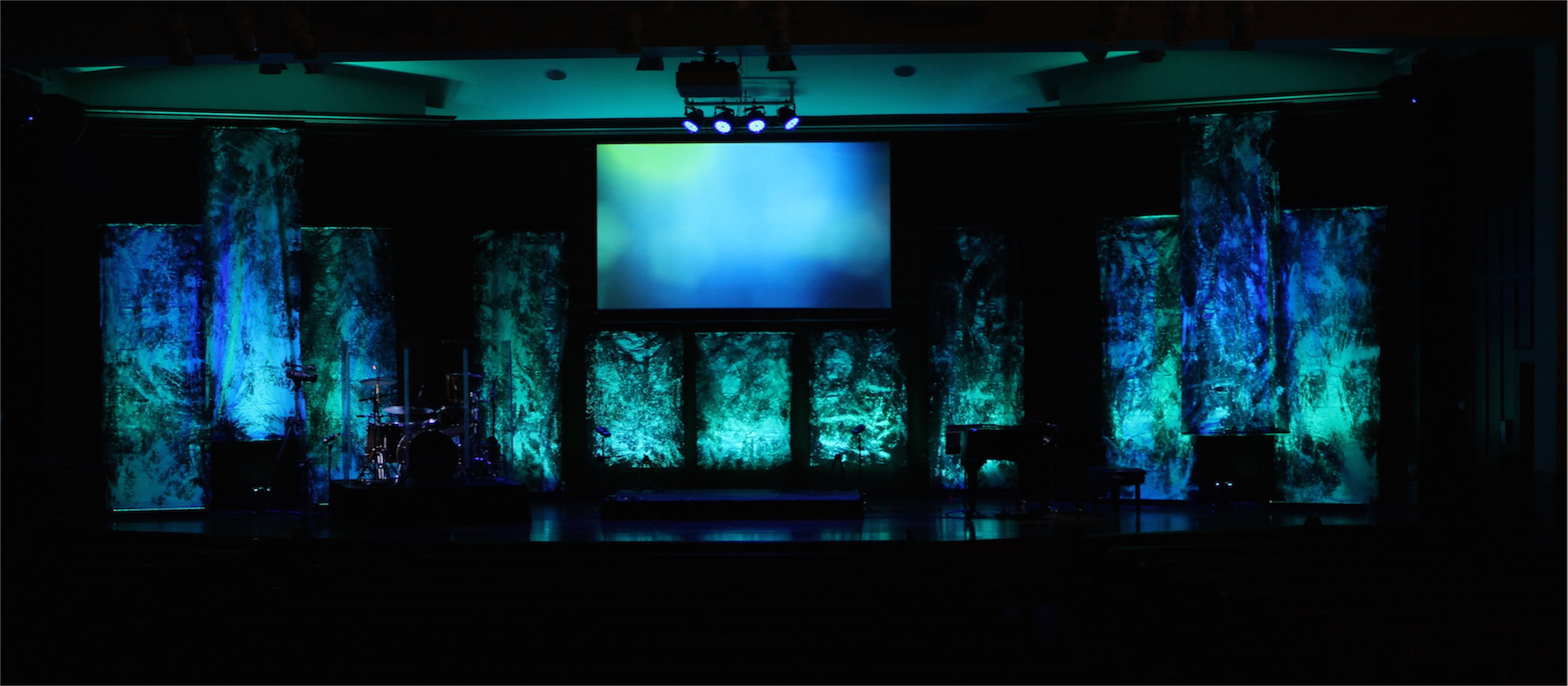
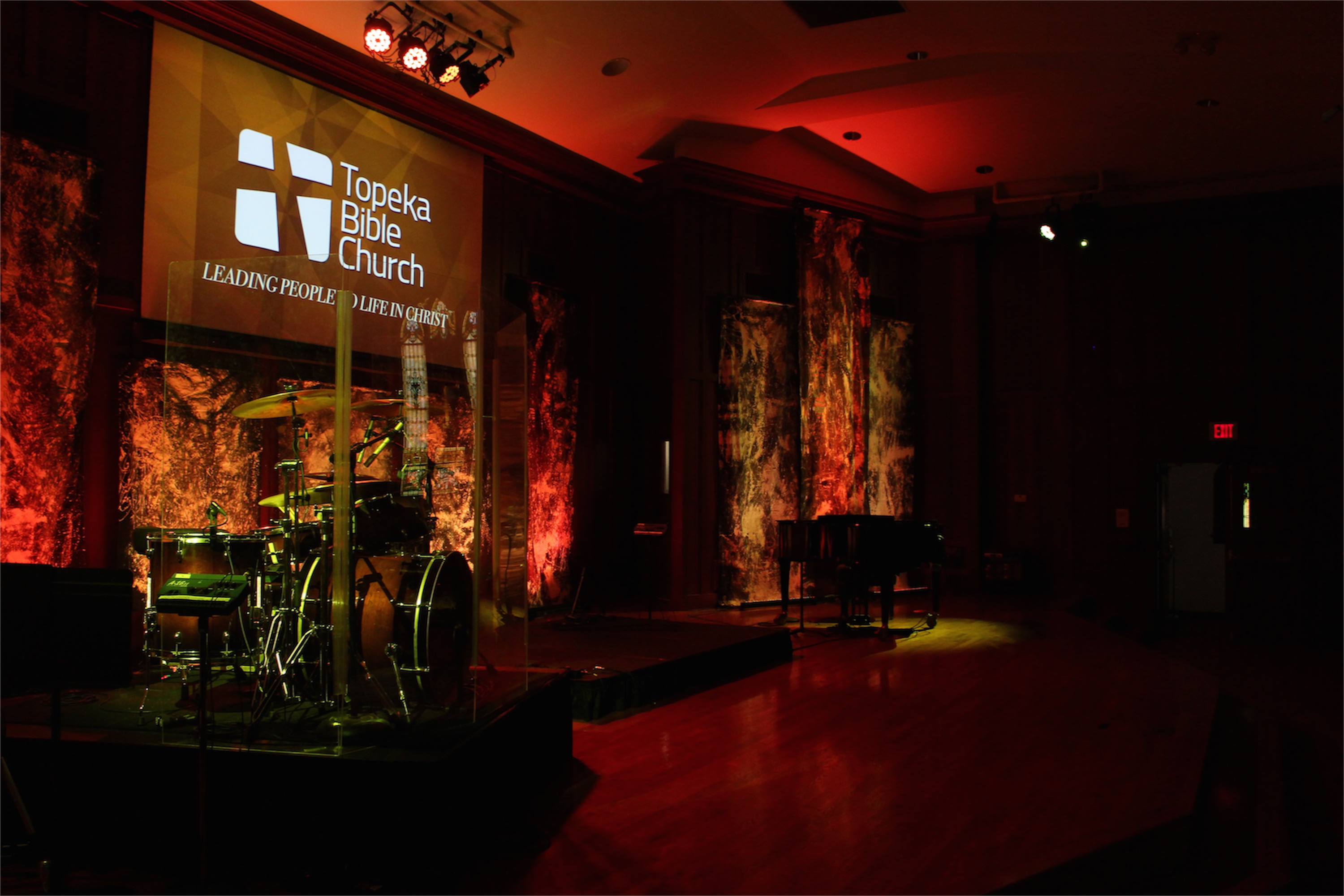
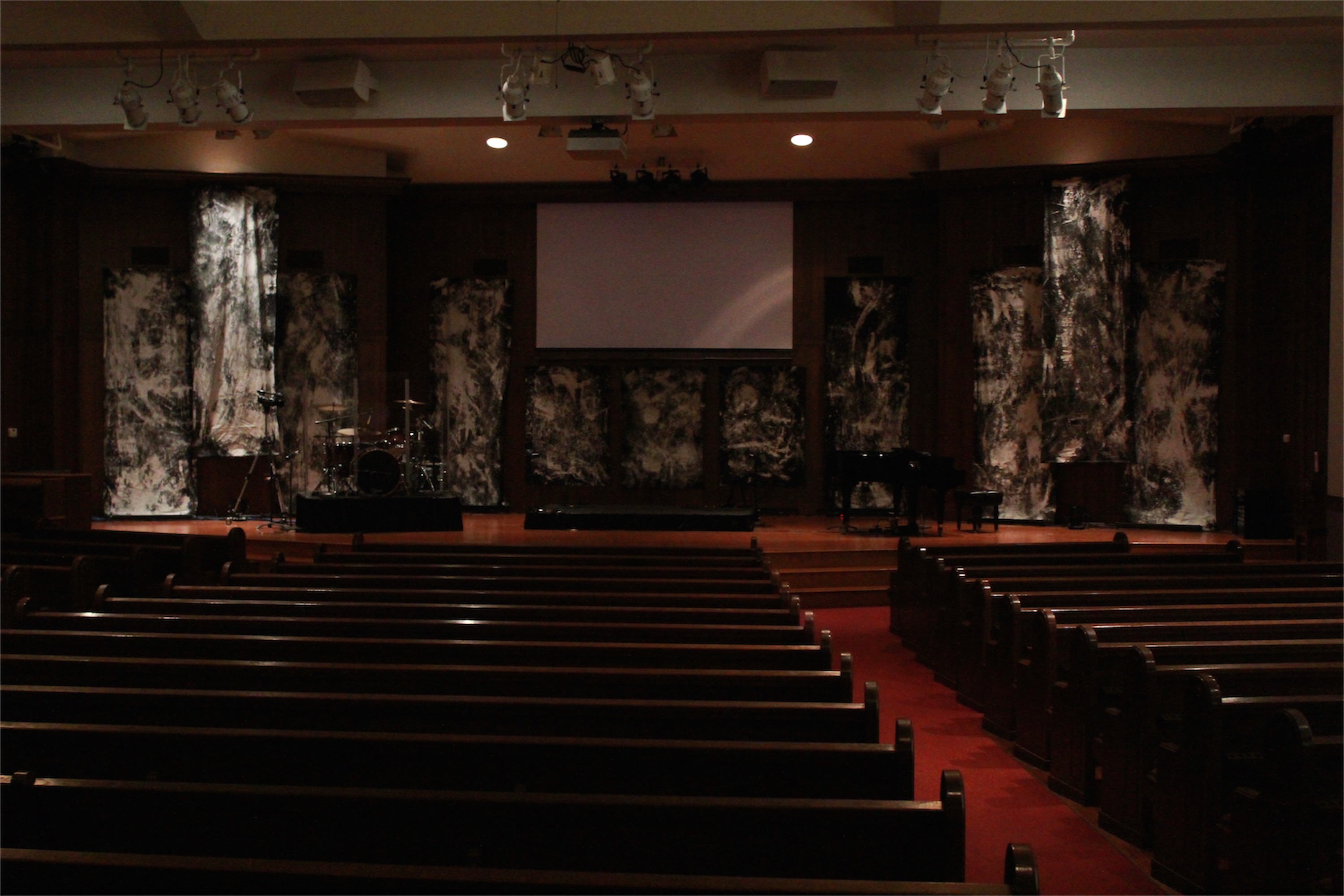
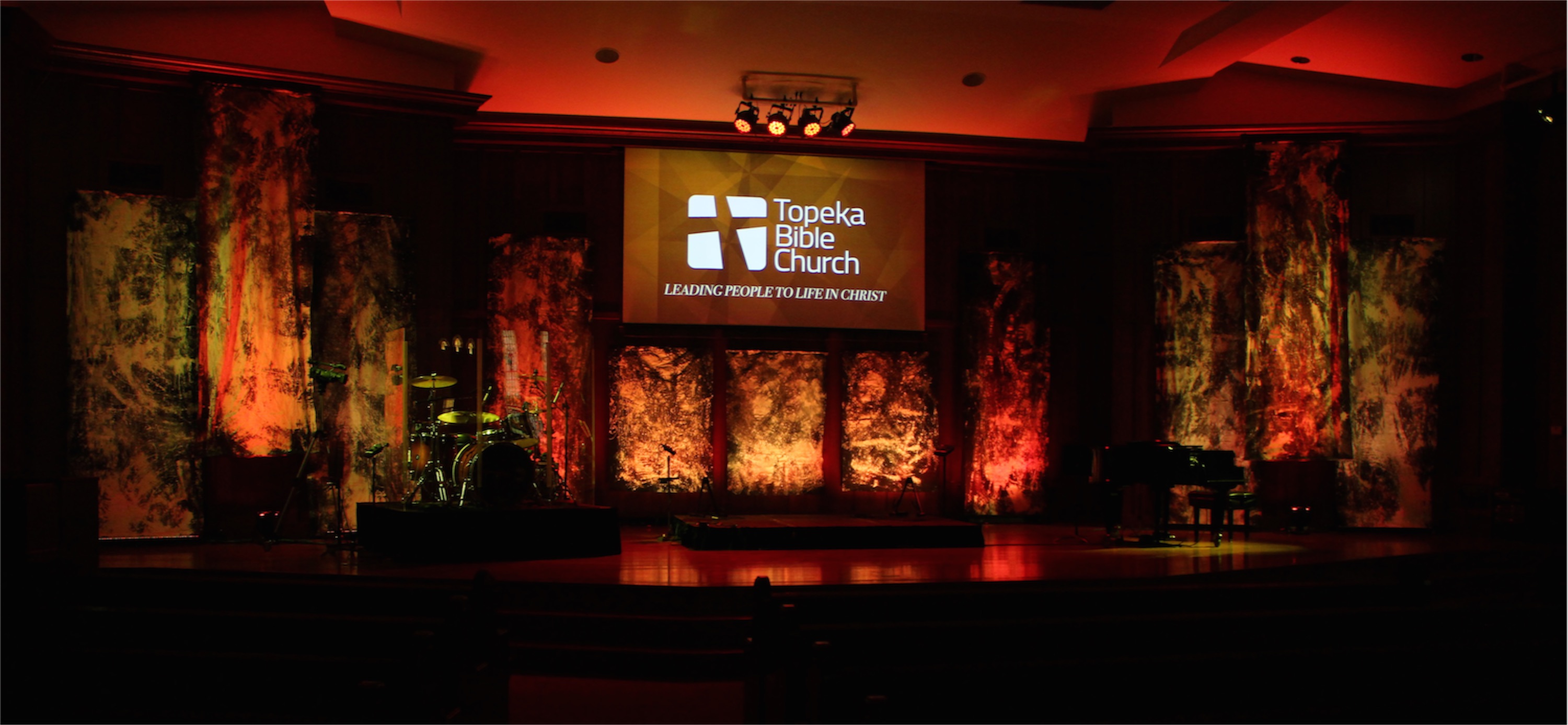
Kaleb Wilcox at Topeka Bible Church in Topeka, Kansas brings us their unique take on the Texturesized design.
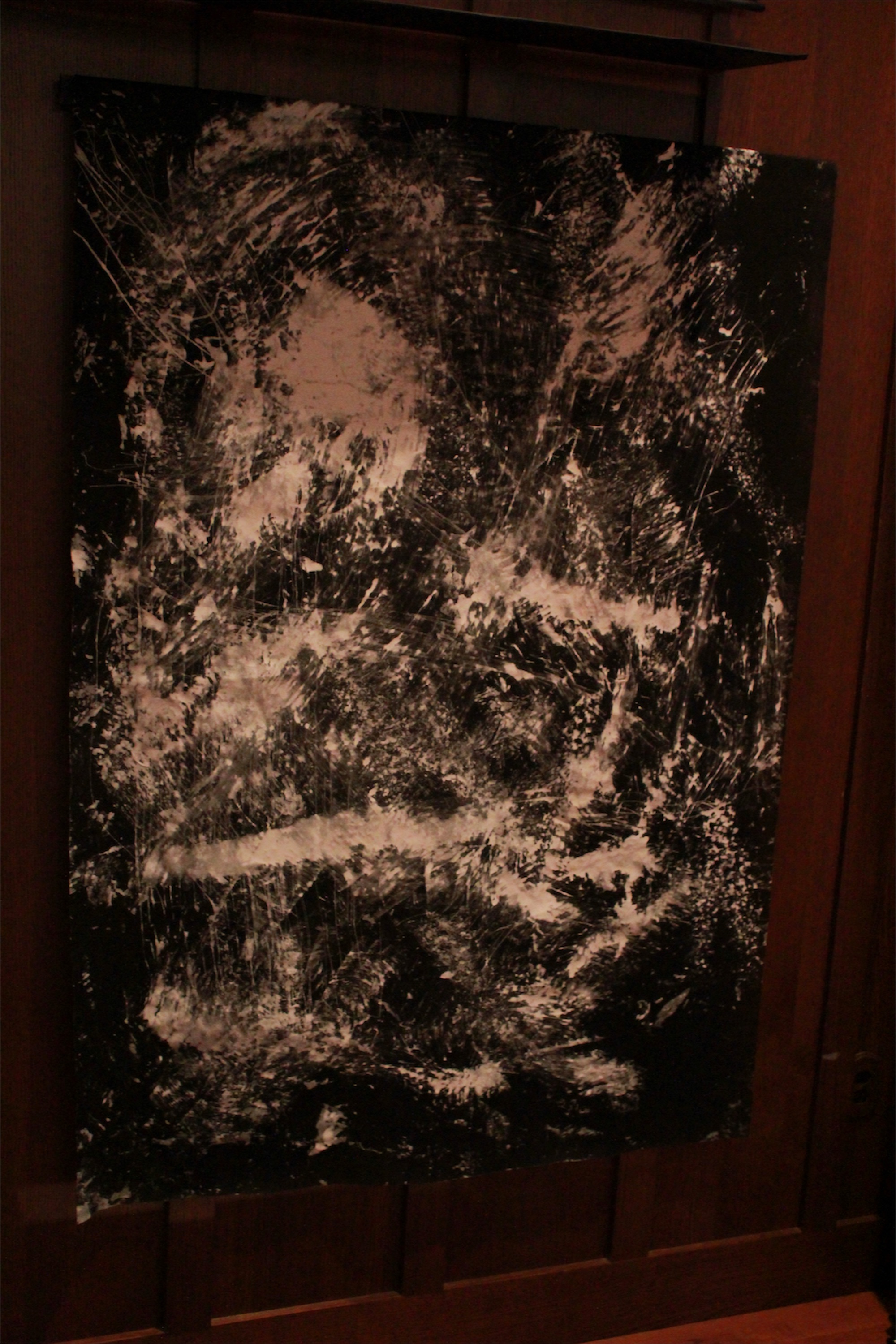
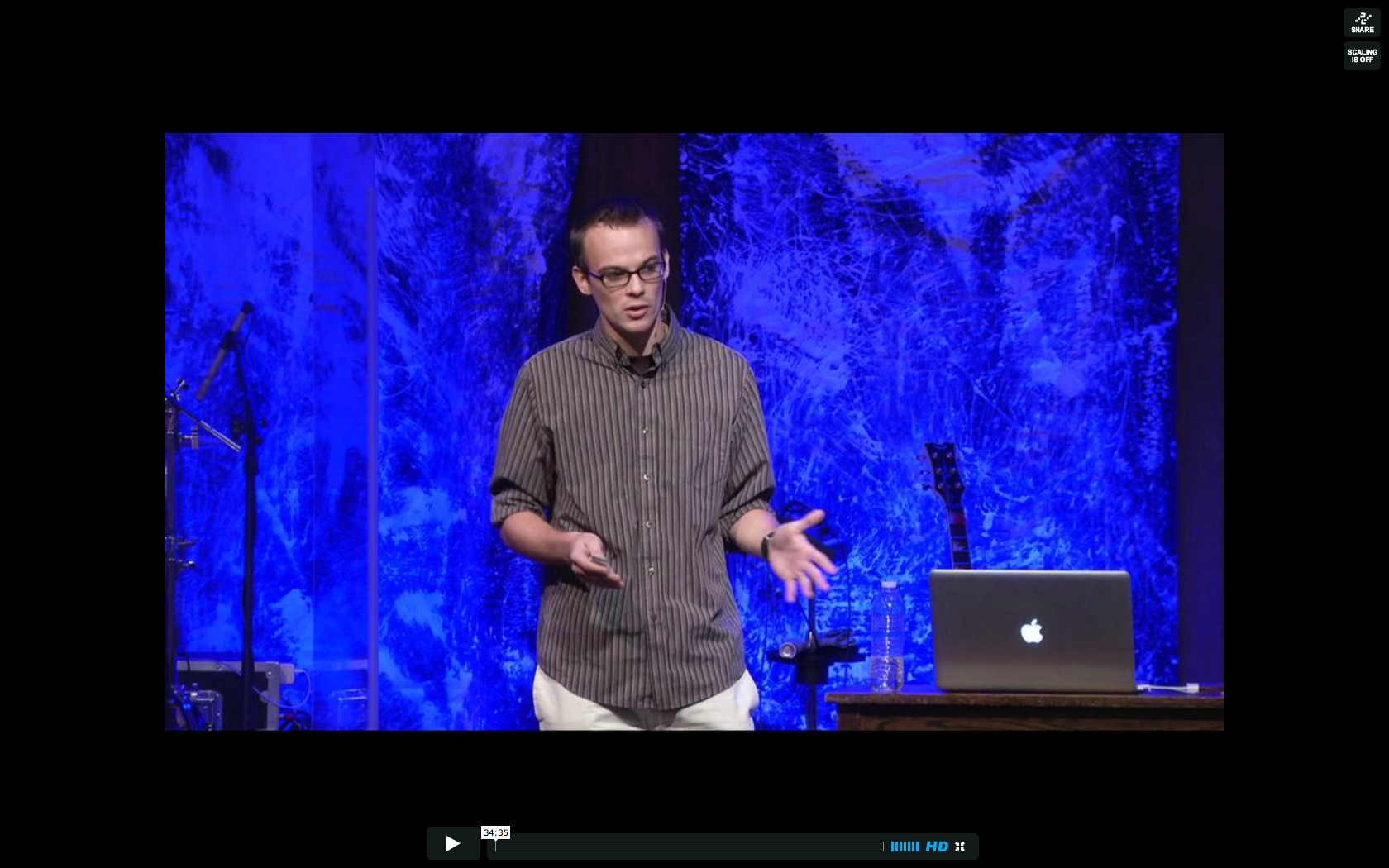
Instead of brooming on the white paint, they splashed the paint onto the landscape fabric. This made it look more like bubbling sea foam – a wave splashing over the stage.
They bought a 4’x100′ role of black landscape fabric, cut it to the needed lengths, then used brooms to randomly splatter flat white paint on them. Then they attached 4′ long 1″x2″ black wood slats to the top and bottom. These wood slats allowed the fabric panels to simply hang off 3″ screw set in the walls.
The set was lit with 9 ADJ Mega Tri Bars, 8 Elation Opti Tri Pars, and 2 Elation Platinum 5Rs.
The Art of Splatter Painting for Church Stage Design
Creating dynamic visual interest on stage doesn’t always require expensive materials or complex construction. The splatter paint technique demonstrated by Topeka Bible Church showcases how a simple change in application method can completely transform the look and feel of a design. By splashing white paint onto black landscape fabric instead of brushing it on, they achieved an organic, bubbling sea foam effect that evokes the power and movement of ocean waves.
This approach to stage design offers several advantages for churches working with limited budgets and volunteer teams. Landscape fabric is remarkably affordable and readily available at any hardware store or garden center. A single 4’x100′ roll provides enough material for substantial stage coverage, and the fabric’s woven texture actually enhances the splattered paint effect by creating subtle variations in how the paint adheres to the surface.
The randomness of splatter painting is both its greatest strength and its most challenging aspect. Unlike brushed applications that can look uniform and controlled, splattering creates unique patterns that cannot be exactly replicated. This organic quality brings life and energy to the stage, suggesting natural phenomena like sea spray, foam, or even cosmic nebulae depending on your lighting choices. Each panel becomes a one-of-a-kind art piece.
Technical Considerations for Paint Splatter Designs
When executing a splatter paint technique, preparation is essential to protect your workspace and achieve consistent results. Lay down drop cloths generously—paint will travel further than you expect. Wear appropriate protective clothing and consider using face shields or safety glasses, as droplets can bounce unpredictably. The Topeka Bible Church team used flat white paint, which provides excellent coverage and light reflection properties for stage lighting.
The viscosity of your paint affects the splatter pattern significantly. Thicker paint creates larger, more defined splatters with raised texture, while thinner paint produces finer mist effects. Experiment on test fabric before committing to your full panels. Some teams achieve interesting layered effects by applying multiple rounds of splattering with varying paint consistencies, creating depth through overlapping patterns of different sizes.
Mounting the fabric panels requires attention to both aesthetics and safety. The wood slat method used here—1″x2″ boards attached to top and bottom—provides weight to keep the fabric hanging straight while creating clean edges. The 3″ screws set into walls must be anchored properly to support the weight, especially if your fabric gets damp from humidity or if you plan to leave the installation up for extended periods.
Lighting Strategies for Textured Fabric Backdrops
The lighting package used by Topeka Bible Church—9 ADJ Mega Tri Bars, 8 Elation Opti Tri Pars, and 2 Elation Platinum 5Rs—demonstrates how versatile LED fixtures can bring textured surfaces to life. The irregular surface created by splattered paint catches light differently across the fabric, creating natural highlights and shadows that add dimension even with simple front lighting.
Color washing works exceptionally well with white paint on black fabric. The white splatters illuminate brightly under colored light, while the black background absorbs light and recedes visually. This high-contrast relationship means you can dramatically change the mood of your stage simply by adjusting colors. Cool blues and cyans enhance the ocean wave aesthetic, while warm ambers and oranges create entirely different emotional territory.
Related Designs
- Texturesized – The original design that inspired this splattered paint variation, featuring brushed white paint on landscape fabric for a different textured effect.
- Flourishing Life – See how repurposed materials like rocking chair parts can create stunning organic shapes and textures for worship backdrops.
- He’s Got the Whole World – Another budget-friendly design using fabric panels from IKEA combined with paper lanterns for under $200.
- Hidden Candle Holds – Learn how Crosspointe Church used pallet wood to create textured vertical towers with integrated shelving.
- Blinder in an Arch – Discover creative lighting techniques using truss-mounted fixtures to add drama and dimension to your stage.
Pro Tips for Splatter Paint Stage Designs
Test Your Technique: Before committing to your full panels, practice splattering on small fabric samples to dial in your paint consistency and throwing technique. Different tools—brushes, brooms, sponges—create different splatter patterns. Record what works so you can replicate it consistently across all panels.
Fabric Preparation: Wash or wipe down landscape fabric before painting to remove any manufacturing residues or dust that might affect paint adhesion. Allow the fabric to dry completely before applying paint. Some teams lightly dampen fabric before splattering to create softer, more diffused edges on the paint patterns.
Safety and Cleanup: Splatter painting is messy by design. Protect floors, walls, and equipment with plastic sheeting and drop cloths. Work in a well-ventilated area and wear appropriate protective gear. Have cleanup supplies ready—wet paint is much easier to remove from unintended surfaces than dried paint.
Storage and Reuse: Painted fabric panels can be stored for future use if properly cared for. Roll rather than fold the fabric to prevent cracking the paint layer. Store in a dry location away from direct sunlight to prevent fading. With proper storage, these panels can serve your church through multiple sermon series and events.


Very nice for a single center screen stage setup.
Wow, this is great. I love the black and white textured idea, very versatile!
I agree. Love the versatility. It adds a nice amount of color without being overwhelming.
Love the design. How big is that projector screen? And how far is it from the projector to the last seat in the room? I have a room that looks about the same size, and we are building from scratch. Just wanted to know sizes and how that works in your room.
Thanks!
@Brandon –
Great question. The screen is 12′ wide by 6.75′ high. Its hit with a 7000 lumen 1920×1080 Sony projector mounted 25′ away from the screen. (You can see it in a couple of the shots) The viewing angle is only about 90 degrees wide because of the shape of our room, with the closest seat in the house being about 30′ from the screen and the farthest seat being about 90′ away. Our room seats 600. For that size of room I definitely wouldn’t want to go any smaller than what we have but also not much bigger. For us, its the right balance between everyone being able to see our content but it’s not dominating the room. We’ve had that size screen for several years but we just made the jump to HD in March. It made a HUGE difference. It was usable before but now, because of the improved resolution, there is no difficulty reading even small text from the back.
Would flow in the dark paint work well with this?
Glow in the dark not flow
I imagine it could but I’ve not tried that. Black-light revealed paint was also an idea we tossed around.
I love this. I am going to forward this to our stage set designer.
What was your approximate cost for this design?
approx. cost was $150 for landscape fabric, paint, wood, and 3″ screws
Thank you!
The 2 Elation Platinum 5Rs. Are they spot lights or beam lights? Where are they located on your stage?
They are hanging on the light bars flanking the far stage left and right. They are spot lights
probably dumb question here….how are these changing colors? Is there light behind them or what?
each piece of fabric has a LED strip light at the bottom.
Where did you purchase the landscape fabric from? Can you get it from lowes? also, what kind fo texture is it??
I bought mine at Home Depot, I’m sure lowes would have it too. its basic black weed block fabric, usually comes in 100′ rolls. The fabric is actually quite thin and can tear pretty easily.
do you think something like this could work? http://www.chauvetlighting.com/products/images/SlimParProTRILG2.jpg
as opposed to using a LED light “bar”?
Kyle we need more than a picture. Can you send the spec sheet on this fixture? Bar fixtures and par fixtures give a different beam angle and would look different but usually will work. Depends on the beam angle.
Where would I find that?
@ Kyle depending on the height of your ceiling and how long the strips of fabric were, yes it could definitely work. I forgot to mention this, but the 2nd fabric from the left and the 2nd fabric from the right are both up lit with Elation Opti-Tri Pars, so pretty much exactly what you’re proposing. It worked great and actually gave a little longer throw then the ADJ LED bars. So if your ceiling is around 15 feet high (like ours) then I can say from experience that the general approach you’re suggesting will work. But remember, the slim par you’re using may have a narrower degree of beam or less output so there are some other variables to consider.
Lowe’s also carries a type of weed block that is a grey texture with black and white fibers running through it. You can use it without having to do to much to it and still get quite an effect.
Thanks Lisa we picked up some yesterday and hope to have our set finished in a couple of days!
Kaleb,
This is very nice! Congratulations!
Kaleb, “Splash” was my favorite set design. Just so cool with the lighting and it gave the stage such a variance of texture with all the wood to have some cloth for softening of the overall appearance. Loved it. We are going to miss you and Sara so very much! God bless!
May I ask of what kind of paint did you use and will pongee cloth do as an alternative of landscape fabric? btw, where did you place the LED lights and what kind of LED lights are these? thanks