


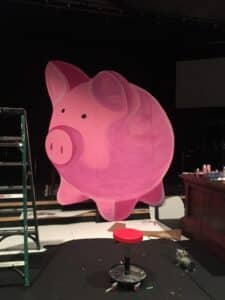
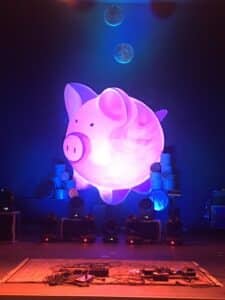
Jeff Sitera from Christ Church at Grove Farm in Sewickley, PA, brings us this piggy bank stage design.
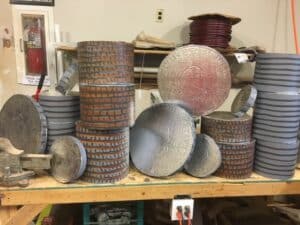
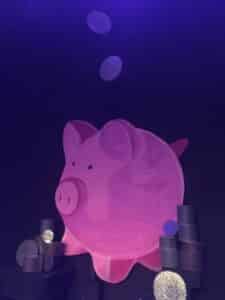
This set was for a series on giving and generosity. Materials were 8 sheets of white cardboard and a furring-strip wood frame for the piggy bank. The coins were made of 1″ styrofoam with silver foil on one side. Jeff found a pic of the piggy bank that he liked, made a transparency, enlarged it using an overhead projector, and hand-painted it. The bank and floating coins were hung with wire.

Adapting This Piggy Bank Stage Design for Your Church
A recognizable object can communicate a sermon series theme before the first slide appears. Here, the oversized piggy bank and floating coins connect the stage directly to giving and generosity. The original build uses white cardboard over a furring-strip frame, with foil-covered foam coins for contrast. The suggestions below are adaptation ideas for your team, rather than additional details from Jeff’s original construction.
Start with a scale sketch of your platform and mark the speaking position, instruments, screens, and walking routes. Give the piggy bank enough space to read as one clear silhouette without crowding the worship team. Check the proposed outline from the back row and through your widest camera shot. If the ears, snout, or coin slot disappear at that distance, simplify those shapes before cutting full-size panels.
For a volunteer-friendly layout, draw the silhouette on a small paper template first. Enlarge it with a projector, or transfer it using a measured grid if a projector is unavailable. Plan cardboard seams around the supporting frame so panel edges have backing. Number the pieces on their reverse sides and photograph a dry assembly; those simple steps make it easier to rebuild the set without guessing where each panel belongs.
Make a sample coin before producing the complete group. Test foam-compatible adhesive on a scrap, smooth the foil carefully, and view it under your actual stage lighting. A reflective surface can create distracting bright spots on camera even when it looks attractive in the room. Adjust the coin angle or the lighting direction before committing to the full arrangement. A painted metallic finish is another option to test if foil reflections prove difficult to control.
Build your shopping list around sheet materials, framing, paint, adhesive, and the approved support system rather than estimating from the photograph alone. The original design used eight sheets of white cardboard, but your quantities will depend on the chosen scale and sheet sizes. Price those items locally, allow for test pieces, and reuse suitable stock where possible. Keep cardboard and foam away from heat sources, and have your facility team review material requirements and placement before installation.
Pro Tips for a Giving and Generosity Set
Keep the silhouette readable: Use a simple background behind the piggy bank. Competing graphics can make the prop harder to recognize from distant seats or a small livestream screen.
Test the complete lighting look: Check the painted bank and reflective coins with both speaking and worship cues. Confirm that the design does not pull exposure away from faces.
Have suspension reviewed: The original pieces were hung with wire, but that is not a rigging specification. Use a qualified person to select attachment points and rated hardware; do not treat cardboard or foam as structural support.
Plan for storage: Label detachable components, protect painted faces, and store coins flat where possible. A documented assembly order helps volunteers reuse the design for another generosity series.
Related Designs
- I Beams – Explore another approach to turning lightweight foam into oversized scenic forms.
- Jesus, Light it Up – Compare a bold message-focused stage with lightweight panels and textured elements.
- Stacked Carefully – See cardboard boxes and foam shapes used in an arcade-inspired design.
- Pointing! – Find a different visual direction for a church generosity celebration.
- Winter Wonderland – Compare another use of lightweight foam-board scenic cutouts.
Related: The Titanic Rises – Explore another recognizable object built with cardboard and wood framing.


That looks really nice!